Fairfield
Zoned for Toxicity
In the early 20th century, Baltimore became the “birthplace of American Apartheid,” where the city’s segregationist policies later served as a model for institutionalized zoning discrimination nationwide (Brown 2019). Racial zoning ordinances that institutionalized segregation and spatial containment created a modern South Baltimore that remains largely inhabited by people of color whose industrial proximity jeopardizes their health, among much else.
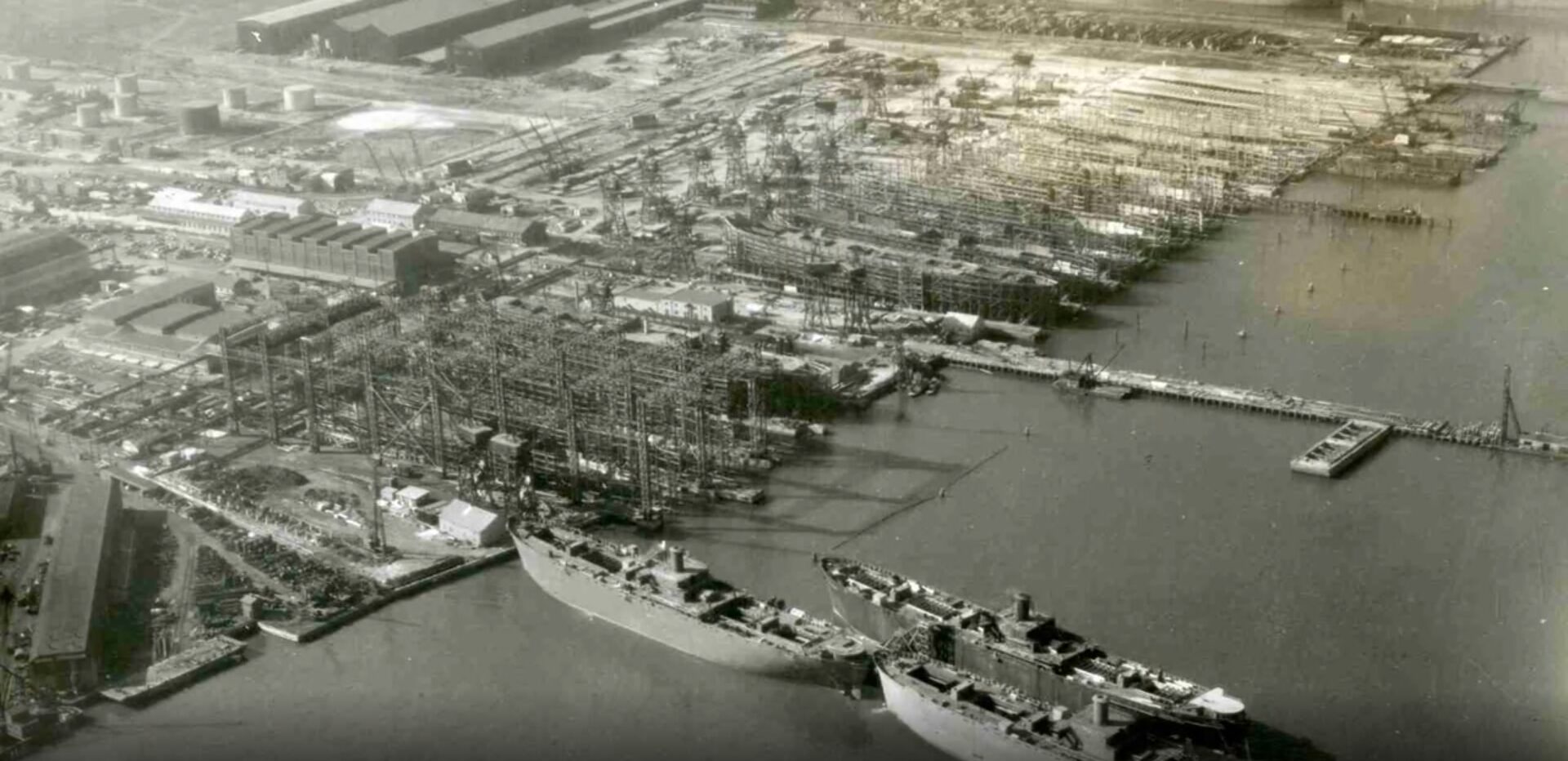
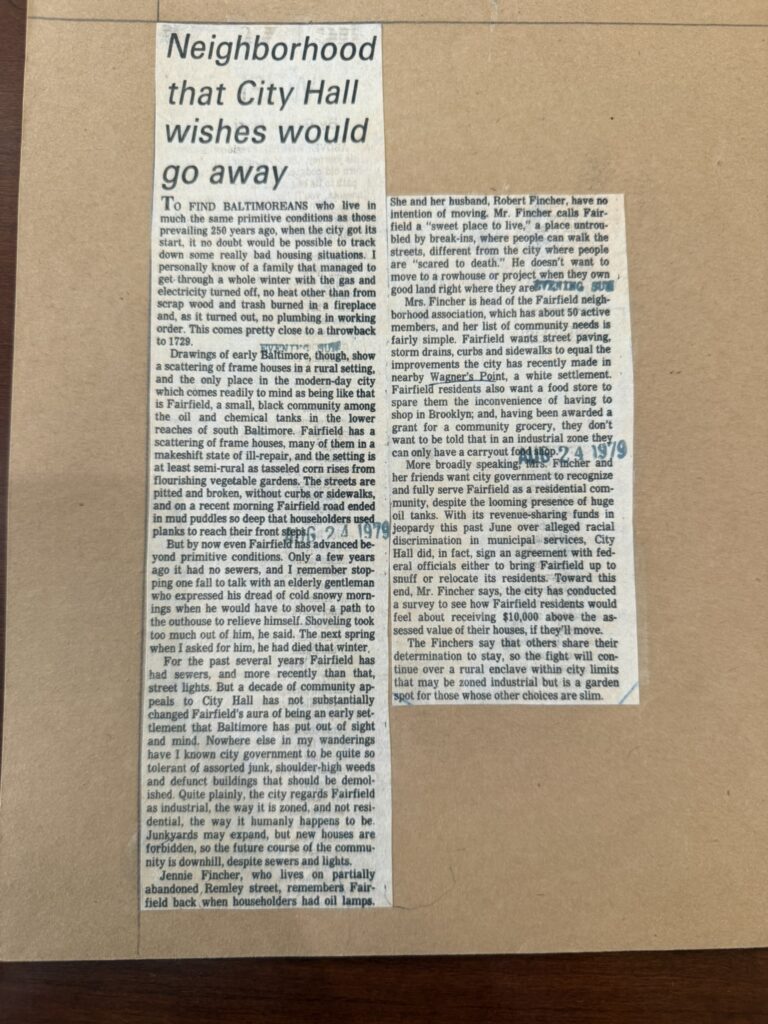
During World War II, additional residential buildings were constructed in Fairfield to accommodate the industrial boom in the area and the unprecedented influx of workers, both White and Black, drawn by the rise of shipyards. Fairfield’s housing outlived the shipyards, becoming segregated, all-Black public housing after White residents moved out postwar, leaving the area without the basic necessary infrastructure for long-term residence. Basic provisions such as streetlights and sewage proved to be a major point of friction between the residents of Fairfield and Baltimore city officials. For example, large portions of the neighborhood never received streetlights or sidewalks and were not connected to the municipal sewage system until the 1970s (Diamond 127-37). Fairfield residents often demanded improved public utilities, but were met with resistance from city officials, who were apprehensive about upgrading an area that was formally classed as industrial.
In addition to inadequate infrastructure and basic services, Fairfield was marked by frequent industrial accidents and severe environmental degradation. Repeated fires and a major chlorine leak in 1986 reflected the dangers posed by nearby factories, which also contributed to poor air quality and exceptionally high cancer rates. These conditions, driven by labor exploitation, weak oversight, and high-risk industrial production, fueled sustained demands for relocation. After years of organizing by residents of Fairfield and neighboring Wagner’s Point, the city ultimately agreed: by 2000, all Fairfield residents had been relocated, and by 2011, the last house was demolished, effectively erasing the community (Environmental Integrity Project, 2012). The fate of Fairfield illustrates how environmental neglect and infrastructural abandonment reflected the city’s treatment of the neighborhood as disposable.
Our documentary tells the story of Fairfield’s erasure and significance. Rather than centering a single protagonist, our film grounds its narrative in an integrated collective memory, pulling from public and personal sources. Voices from those who experienced old Fairfield—like resident Michael Middleton and Victory Elementary crossing guard Ms. Jane—guide viewers through the lived experience of Fairfield: the segregation that shaped schooling and opportunity, the constant presence of industrial odors and pollution, and the gradual displacement fueled by escalating toxic spills and industrial accidents. All of these community-borne, environmentally and politically imbued injustices eventually led to residents’ displacement.
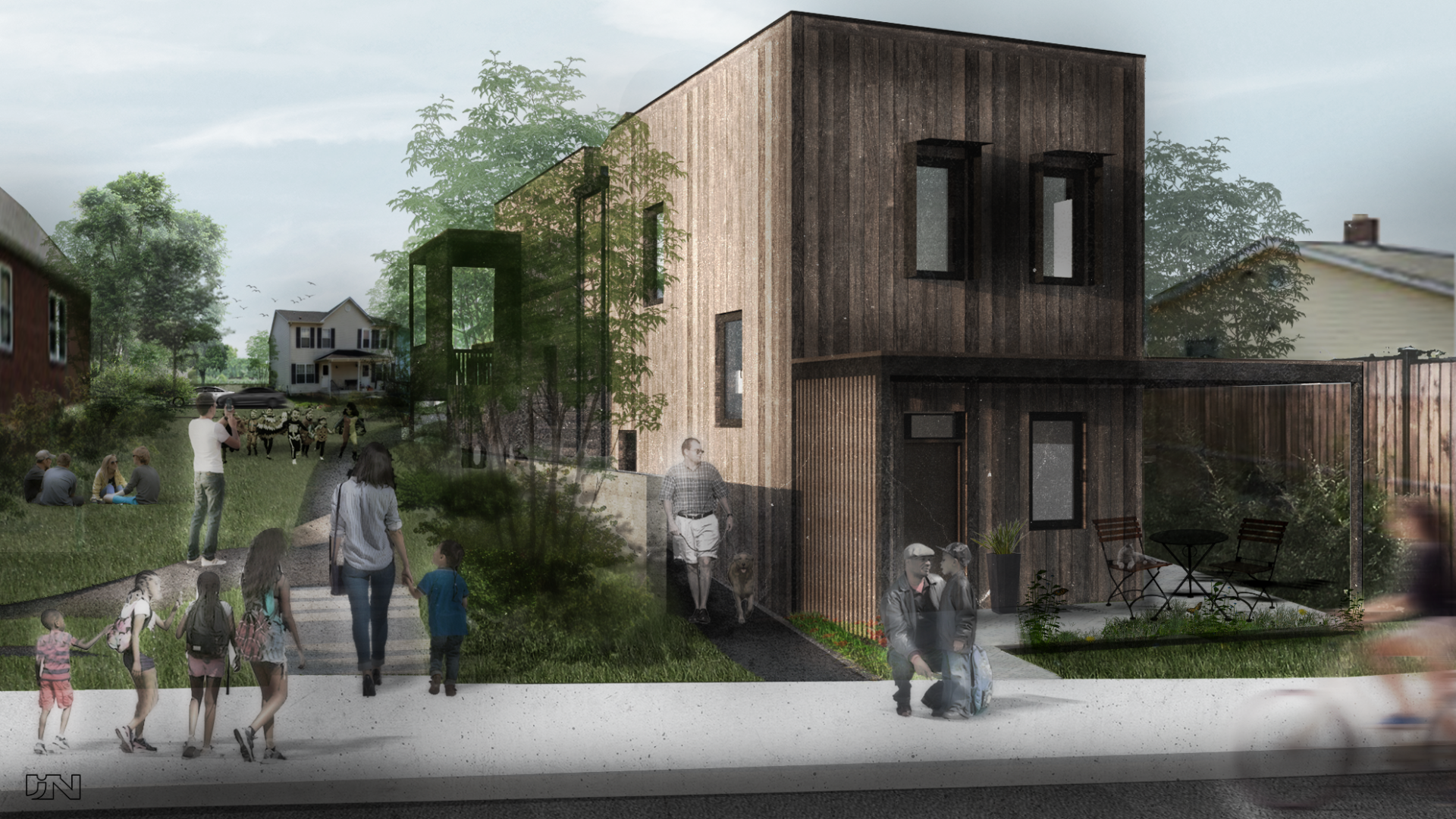
We draw on expert perspectives and archival records to lay the basis for this great loss, to illustrate how Fairfield was rapidly developed into a highly industrialized zone and how this progression influenced its inhabitants, eventually leading to the forced displacement of these residents. Organizers Carlos Sanchez and Shashawnda Campbell pull the viewer into the present by grounding Fairfield’s history in current environmental justice struggles, highlighting organizing work by a youth group called Free Your Voice and the broader movement in South Baltimore. Their advocacy serves as a call to action. The film concludes with residents envisioning what Fairfield has the potential to become, because a future where Fairfield remains forgotten is a future that leaves other communities vulnerable to following the same footsteps.
Through recounting the memories of its past residents and synthesizing expert opinions, Fairfield’s storied and complex identity emerges, acting as a cautionary tale and lesson for other South Baltimore communities, to ensure its fate is never repeated. We hope to reveal how systemic racism and industrial priorities reshaped—and ultimately erased—an entire community.
Additional Resources on Episode 2: Fairfield
- How did Baltimore’s 1910 residential segregation ordinance help lay the legal and spatial groundwork for Fairfield’s later use as an industrial and waste-intensive zone?
- Given Fairfield’s erasure, what responsibilities—if any—do the city and private developers have to acknowledge past harms and invest in repair rather than extraction?
- Ahmann, Chloe. 2024. Futures after Progress: Hope and Doubt in Late Industrial Baltimore. University of Chicago Press.
- Anft, M., & McGovern, M. (1989, September 14). The city’s chemical belt tightens around south Baltimore. City Paper, pp. 14–17
- Badger, Emily. 2015. “The Long, Painful and Repetitive History of How Baltimore Became Baltimore.” The Washington Post, April 29, 2015. https://www.washingtonpost.com/news/wonk/wp/2015/04/29/the-long-painful-and-repetitive-history-of-how-baltimore-became-baltimore/.
- Baltimore City Department of Planning, Historical and Architectural Preservation Division. n.d. “HISTORY of INEQUITY in BALTIMORE Baltimore City Department of Planning, Historical and Architectural Preservation Division.” https://planning.baltimorecity.gov/sites/default/files/History%20of%20Inequity%20in%20Baltimore%209-12-18.pdf.
- Buyout Footage Historic Film Archive. 2014. “HD Historic Archival Stock Footage WWII – U.S. Shipyards Hit All-Time Record! 1942.” YouTube. March 5, 2014. https://www.youtube.com/watch?v=F8wPzc1wKjg.
- Brenda B. Blom, Julie Galbo-Moyes & Robin Jacobs, Community Voice and Justice: An Essay on Problem-Solving Courts as a Proxy for Change, 10 U. Md. L.J. Race Relig. Gender & Class 25 (2010).
- Brown, Lawrence T. 2019. “Community Health and Baltimore Apartheid: Revisiting Development, Inequality, and Tax Policy.” In Joshua Clark Davis, Kate Drabinski, P. Nicole King, eds. Baltimore Revisited: Stories of Inequality and Resistance in a US City, 73–81. Rutgers University Press.
- Brown, Lawrence T. The Black Butterfly: The Harmful Politics of Race and Space in America. Baltimore: Johns Hopkins University Press, 2022
- “Chlorine Leak”. WMAR. Carl, Brenda. Channel 2 News. 1986, August 6-7.
- Diamond, Philip, “An Environmental History of Fairfield/Wagner Point” (1998). Legal History Publications. 31. https://digitalcommons.law.umaryland.edu/mlh_pubs/31
- Downthepoint. 2011. “Tour of Wagner’s Point in Baltimore, Maryland.” YouTube. June 16, 2011. https://www.youtube.com/watch?v=dtML7IN4vOk.
- Henderson, P. H. (1994). Local deals and the New Deal state: Implementing federal public housing in Baltimore, 1933—1968 (dissertation). University Microfilms International, Ann Arbor.
- Hoffman, M. (1953). Changes in Baltimore’s Housing, 1940-1950, with Special Reference to the Role of Government (dissertation).
- King, N., & Bradley, S. (n.d.). 3306 Weedon Street. Mapping Baybrook. https://mappingbaybrook.org/2018/03/3306-weedon-street/
- LECLAIR-PAQUET, BENJAMIN. 2017. “The ‘Baltimore Plan’: Case-Study from the Prehistory of Urban Rehabilitation.” Urban History 44 (3): 516–43. https://doi.org/10.1017/s0963926817000219.
- Matthews, Joe . 1996. “Chemical Company Stages Drill to Prepare for ‘Real Emergency’: Practice Run Simulates Leak of Toxic Fumes in South Baltimore.” Proquest.com. 1996. https://www.proquest.com/cv_1703402/pagepdf/2610120032/Record/B1F0317DBF34A6APQ/238?accountid=10267&sourcetype=Newspapers.
- Mcguire, P., & Deputy, A. (1993, March 28). Miss Jennie’s crusade. The Baltimore Sun, pp. 7–15.
- McCraven, Marilyn. 1997. “City Begins Demolishing Huge Fairfield Homes Public Housing Complex: Workers Clearing Site for Use by Light Industry.” Proquest.com. 1997. https://www.proquest.com/cv_1703402/docview/2754400676/C8EA26F7E5BC4AF9PQ/89?accountid=10267&sourcetype=Newspapers.
- PeriscopeFilm. 2020. “‘SHIPWAYS’ WWII BETHLEHEM STEEL VICTORY & LIBERTY SHIP PRODUCTION DOCUMENTARY MD86514.” YouTube. May 30, 2020. https://www.youtube.com/watch?v=VzuF1EtpWEs.
- Power, Garrett, “Apartheid Baltimore Style: The Residential Segregation Ordinances of 1910-1913” (1983). Faculty Scholarship. 184.
- Power, Garrett, “The Advent of Zoning” (1989). Faculty Scholarship. 872. https://digitalcommons.law.umaryland.edu/fac_pubs/872
- Power, Garrett, “Apartheid Baltimore Style: The Residential Segregation Ordinances of 1910-1913” (1983). Faculty Scholarship. 184. https://digitalcommons.law.umaryland.edu/fac_pubs/184_B01_F003.pdf
- Rosenblatt, P. (2011). The renaissance comes to the projects: Public housing, urban redevelopment, and racial inequality in Baltimore (dissertation). University Microfilms International, Ann Arbor.
- Siegel, Eric. 1996. “Fairfield Homes Awaits Demolition: 20-Acre Site Holds Key to District’s Rebirth.” Proquest.com. 1996. https://www.proquest.com/cv_1703402/docview/2610151670/C8EA26F7E5BC4AF9PQ/92?accountid=10267&sourcetype=Newspapers.
- Snyder, Brad. 1994. “Ship Bashes Fairfield Pier, Causing a Spill: But No Harm to Wildlife Expected.” Proquest.com. 1994. https://www.proquest.com/cv_1703402/pagepdf/2289304147/Record/B1F0317DBF34A6APQ/293?accountid=10267&sourcetype=Newspapers.
- South Baltimore Community Land Trust. 2024. “Complaint Under Title VI of the Civil Rights Act of 1964 against the City of Baltimore.”
- Taeuber, K. (2003, April 23). Public Housing and Racial Segregation in Baltimore. U Balt. http://archives.ubalt.edu/aclu/pdfs/R0002_ACLU_S03A
- Unknown. 1910. “Baltimore Tries Drastic Plan of Race Segregation; Strange Situation Which Led the Oriole City to Adopt the Most Pronounced “Jim Crow” Measure on Record.” Sundaymagazine.com. 2010
- Williams, R. Y. (1998). Living just enough in the city: Change and activism in Baltimore’s public housing, 1940-1980 (dissertation). University Microfilms International, Ann Arbor.